
Exam Accommodations Evaluation
Accommodations let an exam measure what you know when a disability affects reading, processing, or speed. Requesting them is a matter of equitable access.
Moxie Spectrum provides testing accommodations evaluations by telehealth for the LSAT, MCAT, USMLE, bar exam, GRE, Praxis, EPPP, and other professional exams. A licensed clinical psychologist completes the full cognitive and achievement testing that board reviewers expect, so you can test from home and send a report written for the people reviewing it. Waitlists stay short and turnaround times stay efficient. If your deadline falls before the next available opening, rush scheduling outside regular hours is available for an additional fee.

What Testing Boards Look For in Documentation
LSAC, AAMC, NBME, NCBE, and ETS each publish their own guidelines, and the wording differs from one to the next. Read them side by side, and the same expectations keep coming up.
A current DSM-5-TR diagnosis, which is required but never enough by itself
Evidence of functional limitation compared with most people in the general population
Age-based standard scores (NCBE states that percentiles alone are not sufficient)
Named tests and editions from a full battery rather than a brief screener
A history of past accommodations, or an explanation of why there aren't any
A rationale tying each requested accommodation to specific results
Moxie Spectrum reports are built around that list. Scores appear as standard scores, each measure is named with its edition, and every recommendation points back to the data that supports it.
No evaluator controls what a board decides. An objective report documents whatever the testing shows, and that independence is part of what gives the documentation weight with reviewers.
Why Learning Disorders Drive So Many Accommodation Requests
Dyslexia is one of the most common reasons professionals need testing accommodations, more often than autism. Professional exams are long, timed, and packed with dense reading. Slower reading speed or reduced accuracy costs points that have nothing to do with what a candidate knows, and extended time gives those points back.
Strong students often compensate for years. They reread passages and put in far more study hours than classmates. Grades stay high, so nobody suggests testing until a practice LSAT or MCAT runs out the clock.
Boards know late diagnoses happen. They also expect the evaluator to explain why the difficulty went unnoticed, which is why a detailed school and work history matters as much as the test scores.
Dyscalculia and dysgraphia can affect exam performance too. The evaluation for dyslexia and other learning disorders covers all three.
Documentation Rules by Exam
Guidelines change, so treat this table as a starting point and confirm details on each board's own page before scheduling.
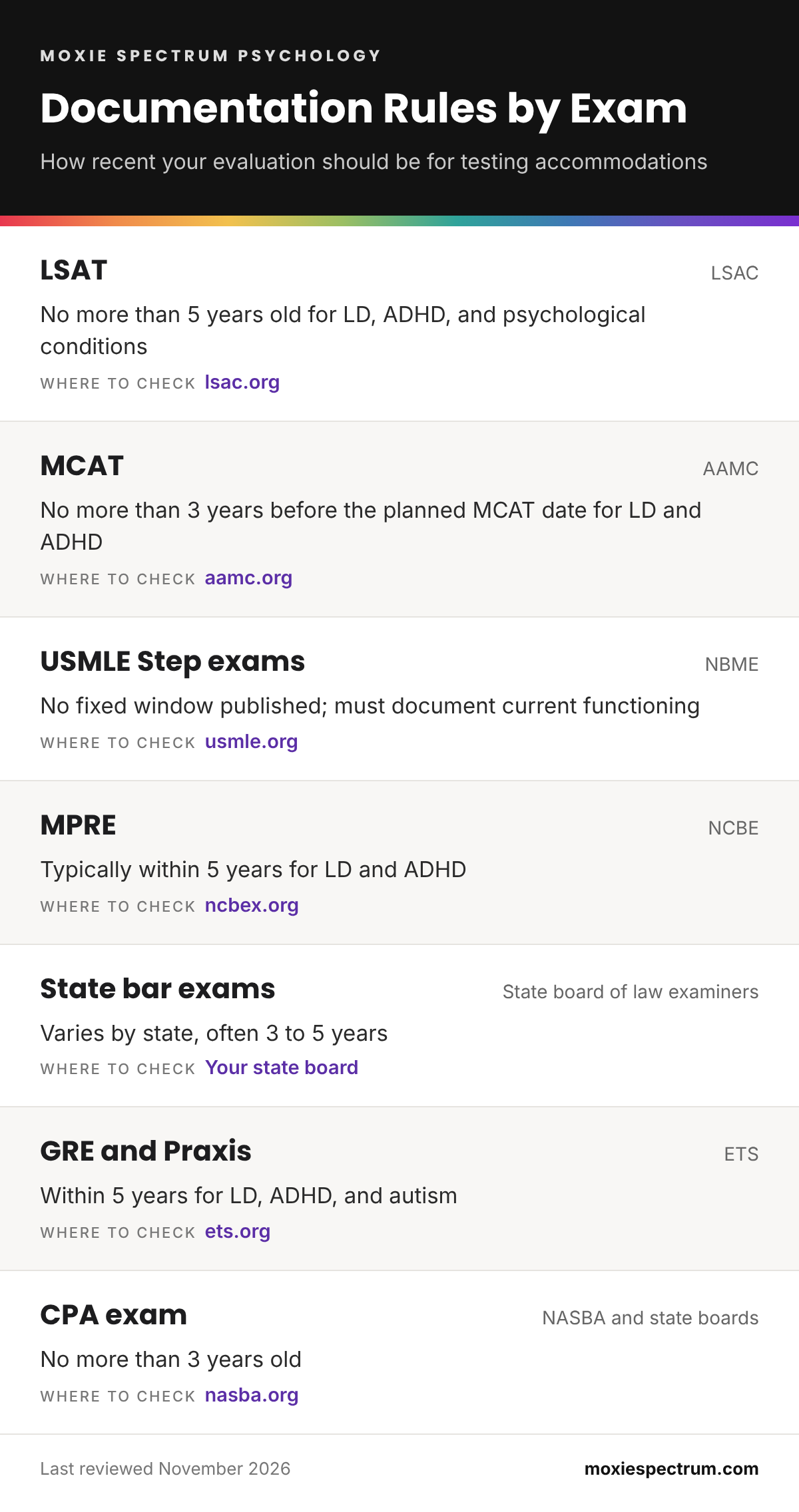
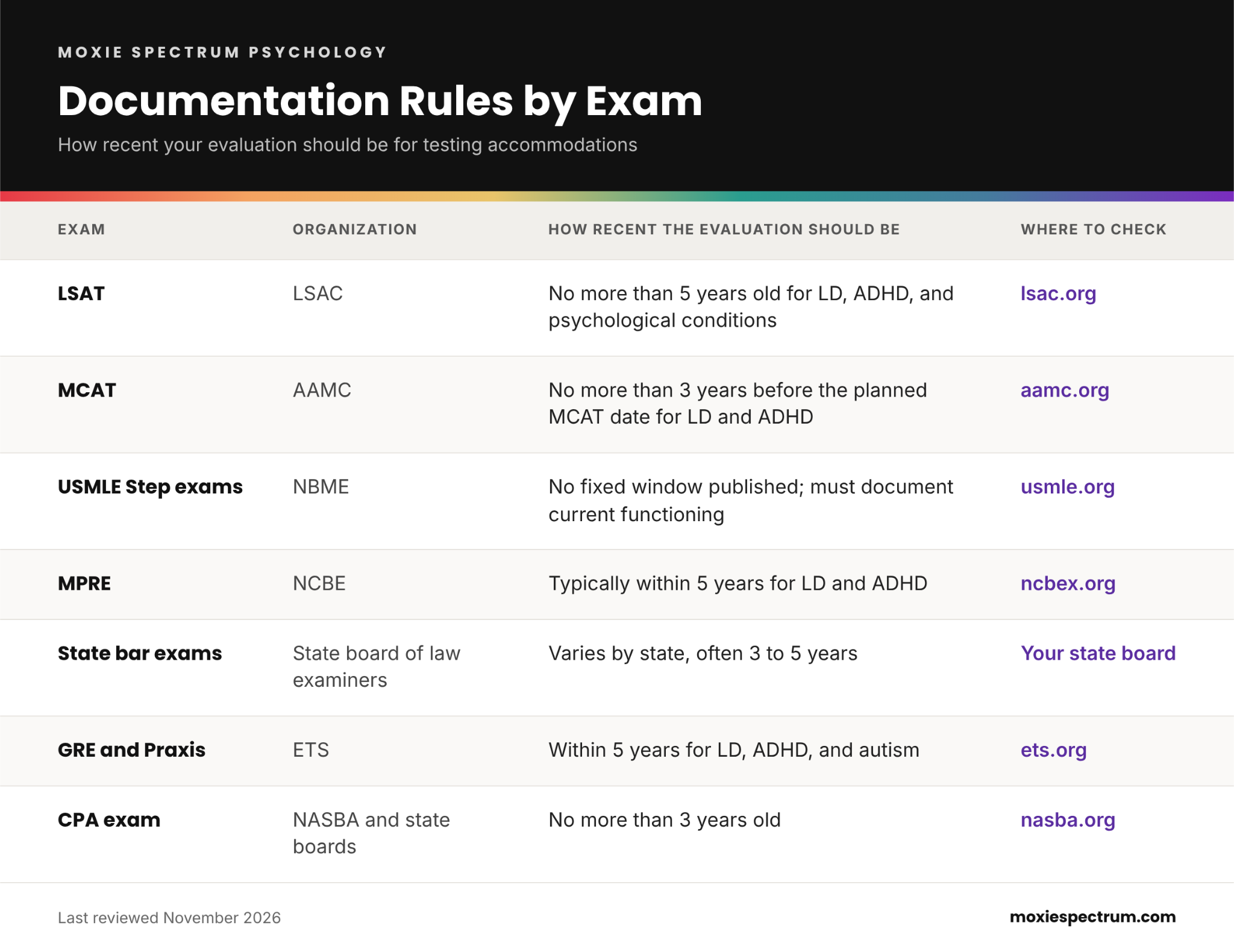
LSAT (LSAC)
Extended time is one of the most common LSAT requests. LSAC wants evidence that supports it, so the evaluation measures how quickly and accurately you read under timed conditions.
MCAT (AAMC)
AAMC gives considerable weight to accommodations received in the past. Reviewers ask for prior SAT, ACT, and GRE score reports, and they want the evaluation completed by a doctoral-level professional who personally assessed you.
USMLE (NBME)
An MCAT approval doesn't carry over. NBME reviews each request on its own, and some candidates receive less extra time on Step 1 than they had on the MCAT, which makes a current, thorough report worth having before the first Step exam.
MPRE and State Bar Exams
NCBE handles MPRE requests, while each state sets its own rules for the bar exam itself.
Virginia asks for testing within 5 years of the filing deadline
Maryland asks for testing within 3 years if you've never been accommodated
Tennessee asks for testing completed after age 18 and within 5 years, with validity measures and a timed reading test normed on adults
GRE and Praxis (ETS)
One set of ETS documentation standards covers both exams, so a single current evaluation can be planned around both.
Other Exams (GMAT, NCLEX, CPA, EPPP, DAT)
North Carolina's CPA board requires an evaluator with experience assessing adults for learning disorders. Requirements for the GMAT, NCLEX, EPPP, and DAT differ by exam and sometimes by state, so check the testing organization's current guidelines.
Is a Telehealth Evaluation Accepted?
ETS, which runs the GRE and Praxis, publicly states that it accepts tele-assessment and hybrid evaluations. The report has to say which parts of testing were remote and where the examinee and evaluator were located during testing.
LSAC, AAMC, NBME, and NCBE haven't published a telehealth policy in either direction. Their guidelines focus on what the report contains.
Every Moxie Spectrum report describes how testing was carried out, including the remote format and each person's location. Before you schedule, send a short email to your board's accommodations office and ask whether they have a preference.
Moxie Spectrum evaluations are comprehensive cognitive and achievement batteries, exactly like in-person batteries. There is no modification of the testing procedure for telehealth, it is a fully standardized and valid evaluation that includes age-based norms, proficiency scores, standard scores, percentile ranks, and a multidimensional approach for testing. If your exam board wants more information on the type of cognitive and achievement testing used, you can direct them to the Woodcock-Johnson V or the Moxie Spectrum website.
What the Evaluation Includes
Each evaluation draws on several sources so the report shows both your history and how you function today.
A diagnostic intake covering your developmental, educational, and work history
Records review of transcripts and prior score reports, plus any IEP or 504 plan and college accommodation letters
Cognitive and achievement testing with the Woodcock-Johnson V, which carries post-pandemic norms
ADHD and autism measures when the referral question calls for them
Input from people who know you well, with safe alternatives worked out together if involving family isn't an option
A written report with standard scores and a rationale for each recommended accommodation
A telehealth feedback session to walk through results and next steps
Plan Around the Deadline
Board review often takes longer than the evaluation, so the safest schedule works backward from your registration deadline.
1. Free consultation. Your exam, deadline, and history shape which testing you need.
2. Testing day. Most adults finish in a single day, with breaks built in for meals and rest.
3. Written report. Your scores, any diagnoses, and a rationale for each requested accommodation come together in a report written for board reviewers.
4. Feedback and submission. After reviewing results together, you send the report and any board forms with your request.
5. Board review. Expect 3 to 12 weeks. NBME takes about 60 business days for new USMLE requests, NCBE needs at least 25 business days for the MPRE, and ETS typically responds in about 6 weeks.
For a tight deadline, ask about rush order scheduling during your free consultation.

If You Never Had Accommodations Before
Plenty of applicants reach graduate or professional school with no IEP, no 504 plan, and no formal testing. Boards don't treat that as disqualifying, though they will ask why the need is showing up now.
Good grades sometimes get read as proof that help was never needed. A careful evaluation documents the effort behind those grades, such as extra study hours, workarounds, and informal accommodations that kept things afloat until strict time limits made them stop working.
High-masking adults, especially those assigned female at birth (AFAB), are often missed for the same reason. They looked like they were coping.
Start collecting old records early. Score reports, transcripts, and teacher comments help show a long-standing pattern, and they can take weeks to request. High school students can get ahead of this with evaluations for teens preparing for the SAT or ACT.
After a Denial or Partial Approval
A denial letter usually explains what the board found missing. An updated evaluation can address those gaps. Post-assessment support can include completing agency accommodation forms or disability questionnaires, which may carry an added fee. Bring the denial letter to the free consultation so testing can target what the board flagged.
Cost and Rush Order Services
Evaluations are self-pay by debit, credit, or HSA card. Insurance isn't billed, which means no pre-authorization delays and one less place your diagnosis is recorded. A superbill is available if you'd like to seek reimbursement on your own. Partial payment is due at booking, with the balance due by the first appointment.
Fees range from $1,500 to $3,000 depending on the testing needed, and a comprehensive evaluation averages $2,000 to $3,000.
Accommodation-focused evaluations elsewhere commonly run $2,500 to $4,500, while lower-priced letter packets skip the new standardized testing most boards ask for, setting you up for risk of a likely denial.
Moxie Spectrum offers a Rush Order option for individuals with firm deadlines that fall before the next regular opening. When the schedule allows, testing is booked outside normal hours for an additional fee.
Frequently Asked Questions
Can my therapist or doctor write my accommodation letter?
For learning disorder and ADHD requests, a short letter is rarely enough. Boards usually require a full evaluation with standardized testing from a qualified, independent professional such as a licensed clinical psychologist specializing in assessment. A diagnosis letter from a therapist or physician will not meet accommodation requirements for most formal exams across most states.
Do I need a new evaluation for each exam?
Not always. Recency windows differ, and some state bars want documentation specific to the bar exam. Time your evaluation around the strictest exam ahead of you.
Will law or medical schools see that I tested with accommodations?
LSAC and AAMC both state that score reports do not flag accommodated testing.
What if I have ADHD or autism instead of a learning disorder?
Both can support accommodation requests. The Comprehensive Assessment for Neurodivergence evaluates autism, ADHD, and learning disorders together, which helps when symptoms overlap. Options are listed on the Services page, and the autism evaluation for adults has its own page.
Is this evaluation a disability determination?
No. The report documents diagnoses and functional impact for accommodation requests and is not a disability evaluation reportable to a court. Depending on the results, you may be able to use it to start disability proceedings in your state.
What technology do I need for testing?
Every evaluation requires a computer or laptop with a webcam, a reliable Wi-Fi connection, and an iPad (other tablets won’t work). Learning disorder testing also needs a document camera, which Moxie Spectrum can mail to you, or you can order your own. Testing can’t be done on a phone.
Start Before the Deadline Gets Close
Testing early leaves room to respond if a board asks for more information. A free consultation sorts out which testing your exam calls for and how soon it can happen. Evaluations are available by telehealth in DC, Virginia, Maryland, North Carolina, Tennessee, Georgia, and other PsyPact states.