
Child and Adolescent Evaluations
Many parents know something is going on long before a physician or teacher suggests a referral. Moxie Spectrum evaluates children and teens for autism, ADHD, and learning disorders such as dyslexia, and you don’t need a referral or the school’s agreement to get started. A licensed clinical psychologist completes each evaluation by telehealth, so your child can be tested from home. You leave with a written report, a feedback session that walks through the results, and recommendations to bring to school.
Bring what you’ve noticed at home, the school’s feedback, and any reports you already have to the free consultation. You’ll leave with a plan, including which evaluation your child needs, how soon testing can start, and what it will cost. If telehealth isn’t the right setting for your child, you’ll be told so and pointed toward options that are. Services are self-pay and available in Tennessee, Georgia, North Carolina, Maryland, Virginia, DC, and other PsyPact states.

Concerns Evaluated
Each concern below can be evaluated on its own, or all of them together through the combined autism, ADHD, and learning disorder assessment. Though testing for diagnostic clarity is meaningful, comprehensive testing allows parents a fuller picture of the learning conditions in which their child performs best, which aids in more targeted support and realistic expectations.
Telehealth works well for kids who are verbal, can follow directions, and can stay on camera with breaks. Nonverbal children and those with certain visual or physical impairments are better served by in-person testing, and highly oppositional behavior can disrupt a remote session.
Autism
Autism testing uses the Childhood Autism Rating Scale (CARS) for structured observation. The ADOS, a tool many parents have heard of, isn't adapted for telehealth. The CARS covers ages 2 to 99 and pairs with cognitive testing, adaptive measures, and input from parents and teachers.
ADHD
The CDC estimates that 11.7 percent of US children have been diagnosed with ADHD (CDC). Testing includes an IQ test plus measures of executive functioning, working memory, and processing speed, along with rating scales from home and school.
Dyslexia, Dyscalculia, and Dysgraphia
Specific learning disorders, especially when undiagnosed and unaccommodated, can affect your child’s experience of learning, quality of life, and attitude toward school. Dyslexia in particular can cut across multiple subjects, which makes strengths and weaknesses hard to pin down without formal testing. Learning disorders are separate from intellectual disabilities. They can affect a child’s grasp of letters and sounds, word reading, comprehension, number sense, spelling, and written expression.
Dyslexia affects reading, dyscalculia affects math, and dysgraphia affects handwriting and written expression. Testing compares your child’s skills with age norms and with their own intellectual ability. It also looks at how they perform when information is visual or spoken and when tasks are timed or untimed.
Giftedness and Cognitive Profiles
IQ testing can identify giftedness or intellectual disability. It also shows uneven profiles, like a child who reasons well above grade level but reads slowly, which helps explain why strong ability and weak grades show up together.

Why Families Are Waiting So Long
Waitlists are impacted by a shortage of specialty-trained providers, the expense of testing measures, challenges with insurance reimbursement, and the need for ongoing re-testing to maintain eligibility requirements. Moxie Spectrum is designed with these barriers in mind.
The CDC's 2025 report found 1 in 31 eight-year-olds identified as autistic (CDC, 2025), and specialist capacity hasn't kept pace. A 2023 survey found 61 percent of US autism centers had waits longer than four months and 15 percent had waits over a year. Likewise, in Tennessee, UT Knoxville reported in April 2026 that evaluation waits can exceed a year (UT Knoxville).
Learning Disorders in Kids and Teens
The American Psychiatric Association estimates that 5 to 15 percent of school-age children have a learning disorder, most often in reading (APA). Dyslexia frequently overlaps with ADHD, with estimates of 25 to 40 percent, and it can co-occur with autism as well.
Many states now screen young readers, and some schools describe a child as having “characteristics of dyslexia” based on those results. That process can get general supports in place at school faster, though it doesn’t provide a formal diagnosis or formal accommodations for standardized testing. A psychoeducational evaluation requires a specifically trained psychologist and validated, standardized cognitive and achievement batteries to confirm whether a learning disorder is present and what kind of support fits. The Woodcock-Johnson V is the only cognitive and achievement battery designed and validated for telehealth evaluations.
For reading, math, or writing concerns alone, see learning disorder evaluations for dyslexia, dyscalculia, and dysgraphia.
Teens Who Mask
Boys are diagnosed with autism about 3.4 times as often as girls (CDC, 2025), and at a Baltimore-area CDC site, the gap reached 3.9 to 1. Many teen girls and teens assigned female at birth (AFAB) hold it together at school, then come home exhausted, overwhelmed, or in meltdown. Teachers may see a polite, capable student and never suggest testing. Pediatricians may see the discrepancy between parent and teacher reports, and assume a relational problem is happening at home and miss the opportunity for further evaluation.
Parents sometimes recognize their own experience in their teen's evaluation. Moxie Spectrum also offers autism evaluations for adults, including parents.

What a Telehealth Evaluation Looks Like for Your Child
Every evaluation requires a computer or laptop with a webcam, a reliable Wi-Fi connection, and an iPad (other tablets won’t work). Evaluations that include learning disorder testing also need a document camera, which Moxie Spectrum can mail to you, or you can order your own. Your child works from a quiet room, and the full device and internet requirements are on the FAQ page.
Ideally, testing is completed within one day and scheduled (with breaks) throughout a full school day to mimic educational demands and allow for “real-world” observations, followed by a feedback session. However, testing can be separated into more than one day as needed. Parents handle the technology and stay nearby, though you'll usually be out of the room while testing is underway.
How to Prepare
1. Free consultation. Talk through your concerns, your child’s history, and which evaluation makes sense.
2. Intake forms and rating scales. You'll complete these, and teachers fill out their own forms.
3. Records. Gather report cards, school testing, any IEP or 504 plan, prior evaluations, and pediatric notes.
4. Room and device. Set up the space and test the equipment ahead of the first session.
5. Testing sessions. Your child completes the scheduled sessions.
6. Feedback and report. Results are reviewed with you, and the written report follows.
School Evaluations and Private Evaluations
Schools decide whether a child qualifies for services, while a private evaluation explains what is going on and what will help.
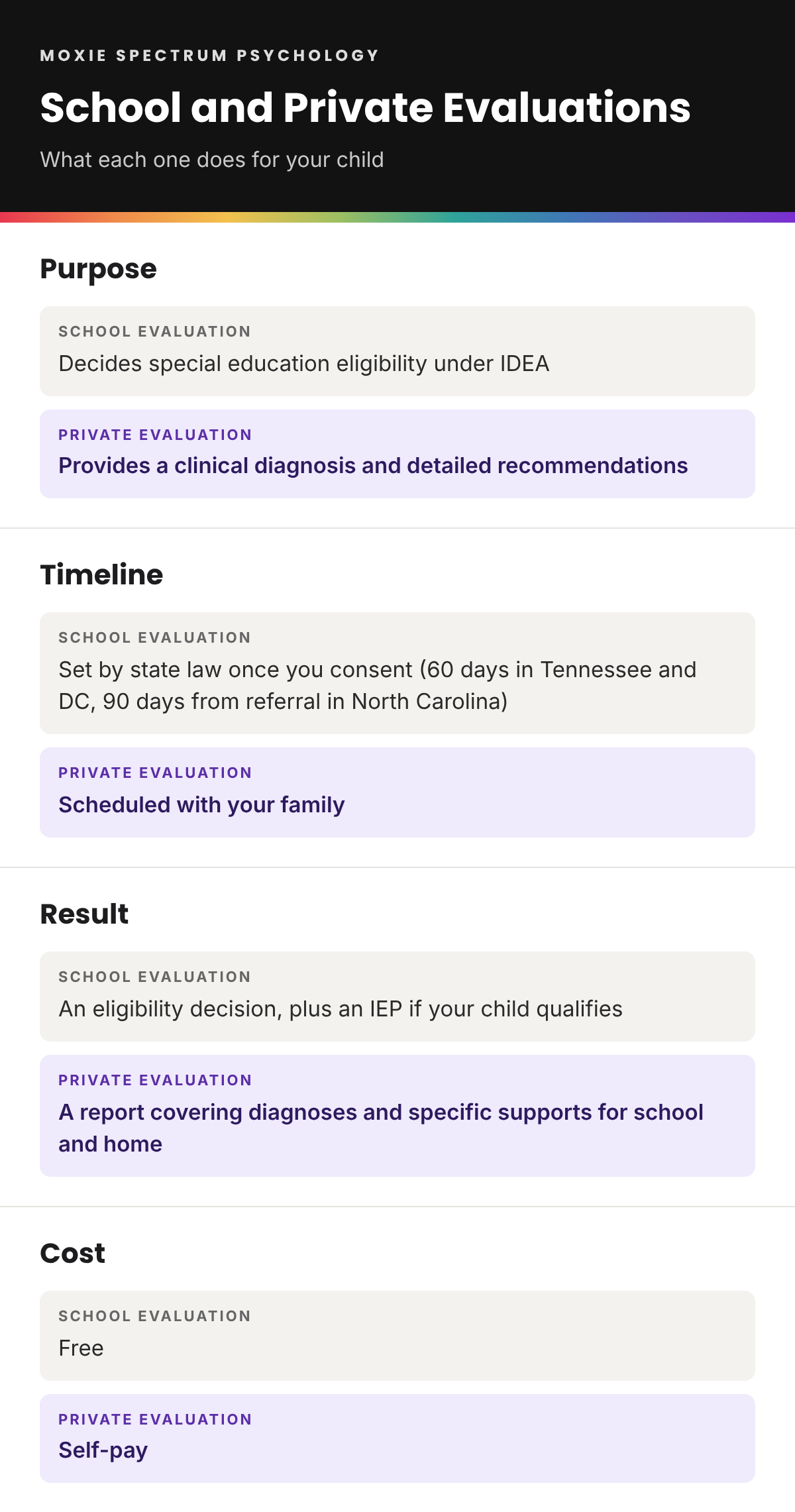
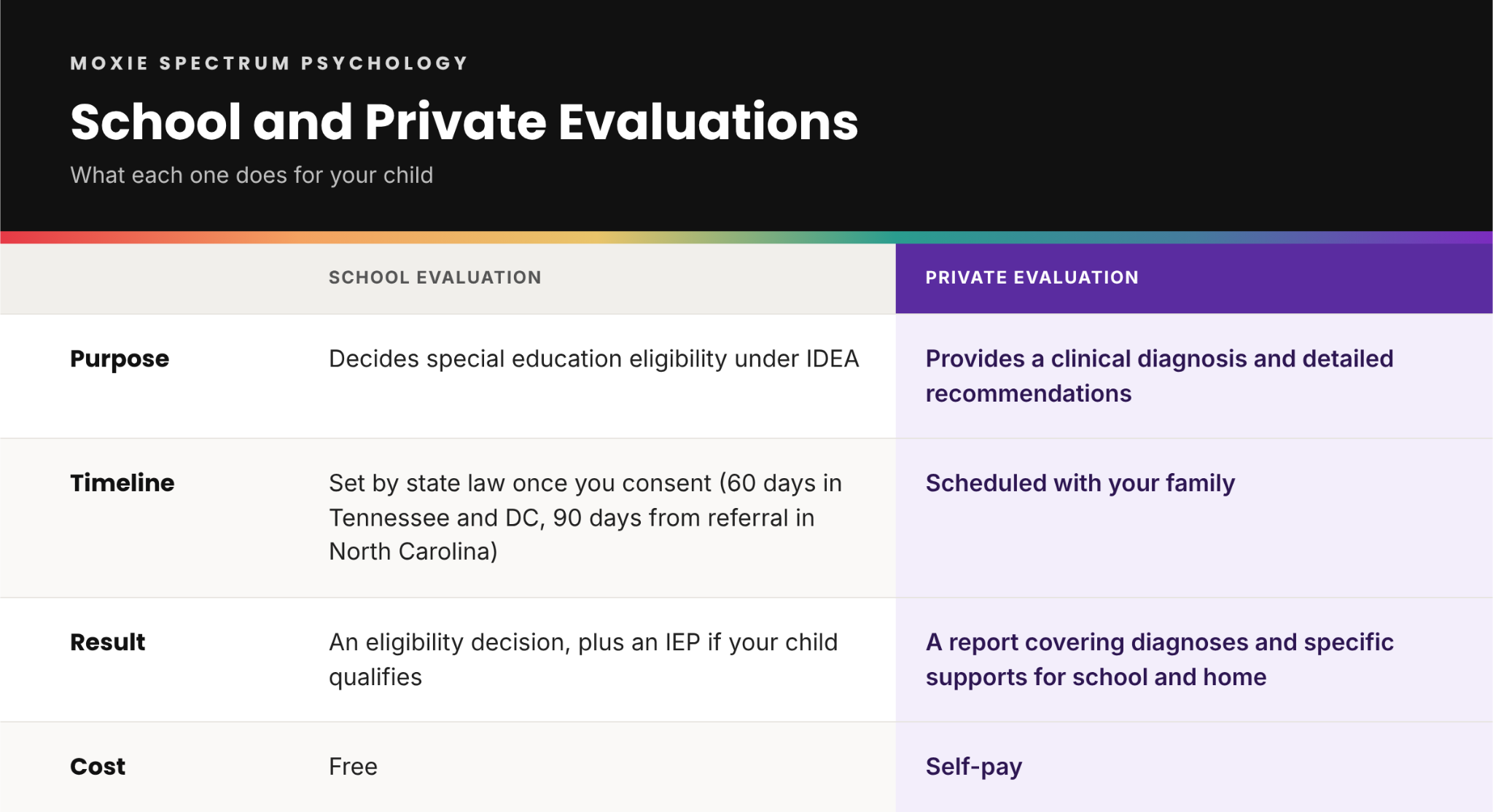
A growing number of families chose private schools, homeschooling, co-ops, forest schools, or online programs after the pandemic. Public districts still have child-find duties for many of these students, but access varies by state, and the process can be slow and unfamiliar for families outside the public system. A private evaluation gives them a direct route to answers.
A private evaluation also keeps the process in your family’s hands. Results come to you first, and nothing goes into a school file or an insurance claim unless you choose to share it. You decide who sees the report and when.
The Report at an IEP or 504 Meeting
Schools must consider an outside evaluation, though they decide eligibility themselves and don't have to adopt every recommendation. Send the report to the school team before the meeting, and ask which recommendations they can put in place for reading help and classroom supports.
Teens Heading to College or Standardized Tests
The College Board and ACT ask for current documentation when a student requests accommodations on the SAT or ACT. Families without a school plan need an independent report, and starting early leaves room for review timelines. AP exam accommodations go through the College Board as well, and the same report can support documentation for SAT, ACT, and later exams.
Teens considering a pre-med path should know that the AAMC looks at whether accommodations were used earlier, including on the SAT and ACT, when it reviews MCAT requests. Documenting needs in high school can make a later request much smoother.
Some exams set rules about how recent testing must be, such as requiring an evaluation from within the past two years, and some require retesting once a teen turns 18. Check each review board’s requirements so the psychoeducational evaluation falls within the needed timeframe, and you avoid denials or delays.
Cost and Payment
Evaluations are self-pay by HSA, debit, or credit card, and a superbill is available if you'd like to seek reimbursement on your own. The testing cost is inclusive of the assessment appointment(s), materials, records review, scoring/interpretation, report writing, and the final feedback session.
Fees range from $1,500 to $3,000 depending on the testing involved, and a comprehensive evaluation averages $2,000 to $3,000. Elsewhere, child psychoeducational and neuropsychological evaluations are generally $2,500 to $5,000 or more. When private testing isn't affordable, your child's school or pediatrician is a good place to start.
Your Child’s Story Matters Here
Bring your questions, your child’s school history, and everything you’ve noticed along the way. The free consultation is a chance to talk it through with Dr. Gouge and decide together whether an evaluation makes sense right now. Consultations are available by phone or video for families in Tennessee, Georgia, North Carolina, Maryland, Virginia, DC, and other PsyPact states.
Frequently Asked Questions
What age can a child be tested for dyslexia?
Signs can appear before formal reading instruction begins, such as trouble with rhyming or learning letter sounds. Formal testing usually starts once reading instruction is underway. On average, most psychologists defer testing for dyslexia until around the second grade, but testing can be done earlier if appropriate.
What is the difference between a neuropsychological evaluation and a psychoeducational evaluation?
A psychoeducational evaluation looks at cognitive ability, academic skills, and conditions that affect learning, such as autism, ADHD, and learning disorders. A neuropsychological evaluation adds a deeper look at brain-based functions like memory, language, and motor skills, often after a medical event or for a complex medical history. Sometimes these terms are used interchangeably when testing incorporates some elements of both.