
Adult Autism Evaluations
High-masking women and adults assigned female at birth (AFAB) often spend years hearing that they seem fine or that it’s just anxiety. Moxie Spectrum provides adult autism evaluations via telehealth, with a focus on this group, and welcomes adults of all genders.
A licensed clinical psychologist completes each comprehensive evaluation, which includes structured observation, IQ testing, and input from people who know you. Services are self-pay and available in Virginia, Maryland, Tennessee, Georgia, North Carolina, DC, and other PsyPact states.

What Masking Can Look Like
Masking, also called camouflaging, is the conscious or automatic effort to hide autistic traits and copy expected social behavior. It can mean scripting small talk ahead of time, forcing eye contact, studying how other people react, or holding in stims until you get home. Masking often works well enough that nobody suspects autism. The cost shows up later as exhaustion, shutdowns, or burnout.
Labels That Often Come First
Anxiety, depression, bipolar disorder, BPD, OCD, ADHD, and eating disorders are common first diagnoses for autistic women. Some are accurate and co-occur with autism. Others describe the strain of masking, or of living in systems that weren’t designed with neurodiversity in mind, without naming the source.
Signs That Bring Adults to an Evaluation
Women in the SPARK study who were diagnosed as adults received that diagnosis at 31.8 years old on average. Many looked successful on paper for years while struggling privately, and a specific moment usually prompted the search.
A child or sibling was diagnosed, and their traits look familiar
Burnout after years of holding everything together, sometimes triggered by perimenopause or a breakup
Sensory overload at work that coworkers don't seem to notice
Recognizing yourself in a late-diagnosed creator's videos or posts
A therapist raising autism during treatment for something else
Realizing you felt calmer during lockdown, when social demands dropped away
A major life change that disrupted routines, such as starting college, moving in with new people, becoming a parent, or starting a new job
Moxie Spectrum also evaluates children and teens, so a parent and child can work with the same psychologist.
What the Evaluation Includes
The autism evaluation takes about six cumulative hours and gathers several kinds of evidence, since no single test can confirm or rule out autism.
A comprehensive diagnostic intake covering your development and inner experience
Records review, such as school reports or prior evaluations
An IQ test
An adaptive behavior composite showing how daily living skills hold up
A sensory intake
Social responsiveness data
Input from collateral reporters who know you
Structured, autism-specific behavioral observation and coding
Why the CARS Instead of the ADOS
The ADOS is the observation tool most people have heard of, but it isn't approved or adapted for telehealth delivery. Moxie Spectrum uses the Childhood Autism Rating Scale (CARS) for observational coding instead. Despite the name, the CARS covers ages 2 to 99 and goes well beyond a rating scale. It involves standardized observational coding of visual, verbal, and interactive prompts given during testing. Its flexible administration suits telehealth and improves cultural, social, and racial inclusivity.
Dr. Gouge has received hands-on training from one of the CARS2-HF founding developers, Dr. Mary E. Van Bourgondien, through the TEACCH Autism Program at the UNC Chapel Hill School of Medicine, including coding interrater reliability.
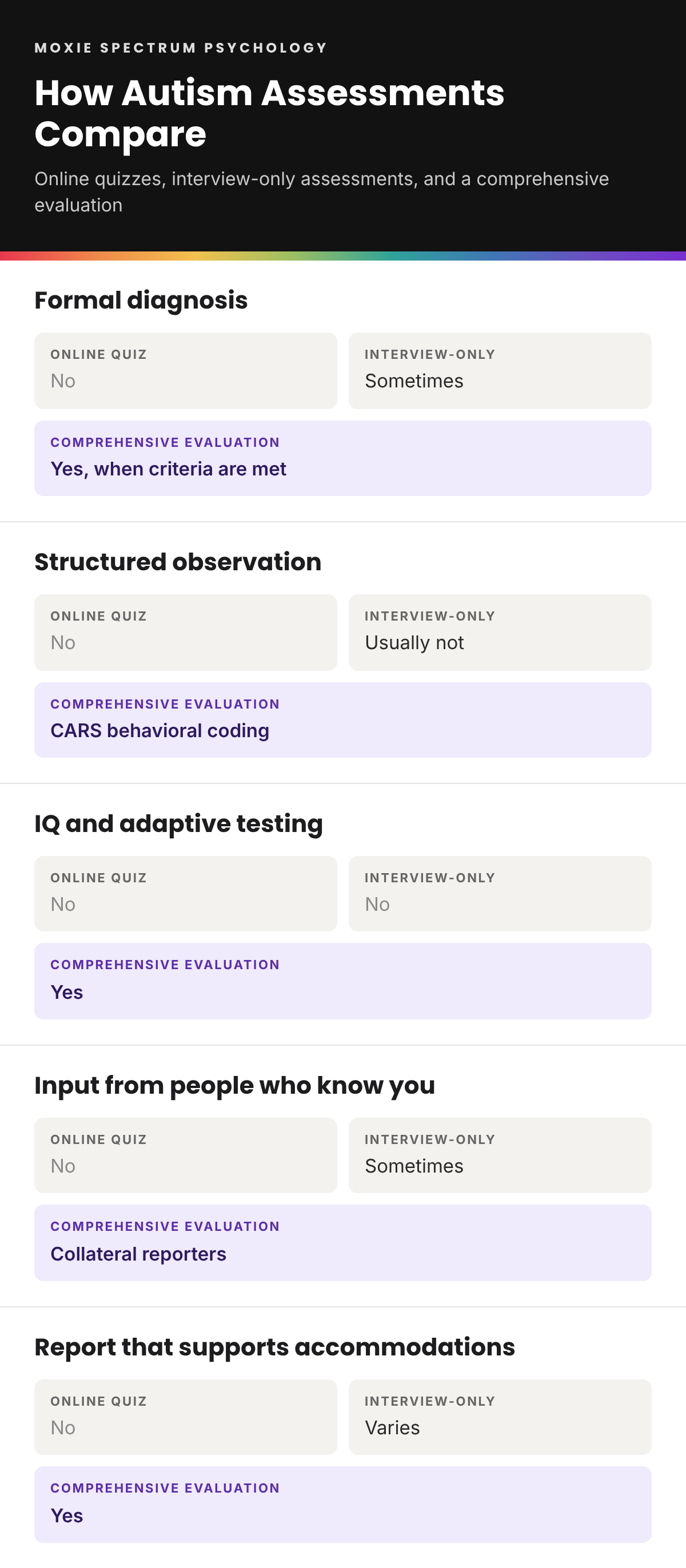
Online Quizzes, Interview-Only Assessments, and a Comprehensive Evaluation
Screeners can be a useful first step, and many people arrive having taken several. They work best as a reason to seek an evaluation.
Autism, ADHD, or Both
Between 50 and 70 percent of autistic people also have ADHD (often referred to as AuDHD), according to a 2022 review by Hours and colleagues. Each condition can hide the other. ADHD restlessness may hide an autistic need for routine, while deep autistic focus can make attention problems easy to overlook. The combined autism and ADHD assessment evaluates for both in about five cumulative hours. Testing for co-occurring learning disorders can be added, for a total of about eight cumulative hours of active testing. For reading, math, or writing concerns on their own, see learning disorder testing for dyslexia, dyscalculia, and dysgraphia.
Autism, Anxiety, Trauma, or BPD
In one registry, roughly 62 percent of autistic women had received another psychiatric diagnosis first, compared with 37 percent of autistic men. Earlier clinicians weren't necessarily wrong. Anxiety and trauma responses are common in autistic adults, and overlapping traits make the picture hard to sort out from symptoms alone.
Undiagnosed autistic women also face a higher risk of exploitation and victimization, which can raise rates of trauma and, in turn, PTSD and BPD. BPD itself is often better understood as a trauma response than a personality disorder. In other cases, clinicians lack current training in how to evaluate autism in adults, especially high-masking AFAB adults with complex histories.
Research in women and AFAB adults points to a few distinguishing features. Identity disruption best separated BPD from autism, while sensory differences and a strong need for sameness pointed toward autism. A careful evaluation looks at when traits began, whether they appear across settings, and what drives them, so the report can explain which diagnoses fit and why.
Affirming, Gender-Inclusive Testing
Your chosen name and pronouns are used throughout testing and in the written report. Before anything sensitive is documented, the wording is decided with you, so you have a say in what goes on record.
Many scoring systems still require a binary gender. When one does, the choice of norms is made with you, whether that means age-based norms, sex assigned at birth, norming on both, or the option that carries the least risk for you.
Input from someone who knew you as a child or knows you well now is part of the evaluation. If involving family isn't safe or possible, other options that still meet testing standards are worked out with you. The FAQ page explains more about how gender-inclusive testing works.
How Telehealth Evaluation Works
Testing from home means your own lighting, sounds, and comfort items, which helps many autistic adults stay regulated.
1. Free consultation. A phone or video call covers your questions and which assessment fits.
2. Deposit and intake. Partial payment holds your testing date, and intake forms gather your history ahead of time.
3. Testing day. Most adults finish in one day with breaks for meals and recovery. A longer single day tends to show more of your everyday profile than many short sessions, where masking is easier to keep up.
4. Feedback and report. A telehealth feedback session walks through your results, and the written report follows.
Every evaluation requires a computer or laptop with a webcam, a reliable Wi-Fi connection, and an iPad (other tablets won’t work). A document camera is only needed if learning disorder testing is added, and Moxie Spectrum can mail you one, or you can order your own. Phones are too small for testing.

Cost and Payment
Evaluations are self-pay by HSA, debit, or credit card. Insurance isn't billed, which avoids pre-authorization delays and keeps the diagnosis between you and whoever you choose to share it with. A superbill is available if you'd like to seek reimbursement on your own.
Fees range from $1,500 to $3,000 depending on the testing involved, with the highest fees for a comprehensive evaluation that covers autism, ADHD, and learning disorders together. Your exact fee is set during the free consultation. Elsewhere, combined autism and ADHD evaluations commonly run about $2,500 to $4,250.
What a Diagnosis Can Change
The biggest change many adults describe is finally understanding themselves. For high-masking women and AFAB adults, an accurate autism diagnosis can be life-changing, and sometimes life-saving. It can prevent unnecessary hospitalizations (including involuntary commitments), misdiagnoses, and adverse reactions to medications. With the right support and advocacy, it can also help prevent autistic burnout.
Your report explains your profile and why it went unrecognized, and plenty of people bring it to a therapist to plan the support that fits them. It can also support workplace or school accommodations, and professional exams set their own documentation rules for testing accommodations. The report isn’t a disability determination, but it’s thorough enough to start that process.
Many people feel relief afterward, along with grief or anger about the years spent without answers. Your feedback and report will include resources for processing your diagnosis.
Bring Your Questions to a Free Consultation
You don’t need to be sure you’re autistic to book a consultation. Plenty of adults who reach out have been doubted for years, including by themselves. Bring what you’ve noticed, the labels you’ve been given, and your questions about masking. You’ll leave knowing which evaluation makes sense for you and how soon testing could start. We offer telehealth evaluations in Virginia, Maryland, Tennessee, Georgia, North Carolina, DC, and other PsyPact states.
Frequently Asked Questions
Is an online autism diagnosis legitimate?
Yes. A diagnosis from a licensed psychologist after a comprehensive evaluation carries the same clinical weight whether testing happens in person or by telehealth. Quizzes can't diagnose, and services without a licensed clinician can't provide a formal diagnosis.
What if I've already self-identified as autistic?
Self-identification is valid, and many people arrive confident in it. A formal evaluation adds documentation that employers and schools recognize, and it checks whether ADHD or another condition is also present.
Am I too old to be evaluated?
No. Adults are evaluated in their 40s, 50s, and beyond, and a diagnosis later in life can still explain decades of experience and be preventative of autistic burnout.